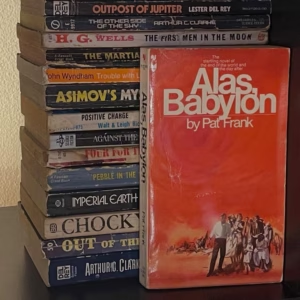
 Alas, Babylon, by Pat Frank, is a post-apocalyptic story, written in 1959, which gives it that fascinating retro look at an alternate future.
Alas, Babylon is very much a Cold War novel, both in the nuclear threat and the general views of American life. The story follows Randy Bragg, a former lawyer in a small Florida town, who get a message from his military brother that the big one is coming. This gives Randy a little time to prepare to host his sister-in-law and his niece and nephew. The book’s title comes from the brothers’ preplanned secret code for disaster-warning telegrams, for real Cold War-fiction vibes. Fortunately, the little town of Fort Repose is fairly rural, and when disaster wipes out communications, the residents are set up well for fishing, citrus farms and general independence.
I notice some similarities with other disaster novels, especially that connection in the military with advance knowledge who gives the main characters a little jump on disaster preparation. The beginning of John Christopher’s No Blade of Grass has a friend in the military giving advance notice and involves two brothers making a pact about how they’ll deal with the coming probable disaster. They’re two wildly different stories, as the band of survivors in No Blade of Grass slowly loses their social humanity in order to survive, and the band in Alas, Babylon start to find their survival in teamwork and cooperation.
This is a noticeable contrast with other disaster novels I’ve read, like George R. Stewart’s Earth Abides or John Christopher’s Empty World, where the protag is saved for unknown reasons and finds himself in the midst of the disaster, with no preparation time. Randy, and then his assorted friends, have a little warning, which makes for a different thought experiment for readers. How would you, the reader, plan for a disaster with a couple days notice? Who would you tell? What would you do with that warning?
At its heart, Alas, Babylon explores how ordinary people respond to catastrophe. There’s still a plot, but the characters could also easily work as personality archetypes, too. Some characters are tested and come out stronger, some can’t handle the new world, and some remain lazy or selfish, no matter what happens. There’s a particularly moving scene when an officious branch manager realizes he has no contact with the main bank, no orders from above, no security, no job and no skills for the new world. The branch manager had been an important man in town, on a bit of a power trip the day before, now he just has a little pile of colored paper.
Mostly Pat Frank writes like he’s a military technical writer. There is absolutely no metaphor or artistry in the descriptions. This doesn’t help character development, but it’s strangely effective for the drama, because the author doesn’t give way to anything wild and crazy like a creative turn of phrase, but writes about nuclear holocaust as if it’s a trip to the store for lightbulbs, razor blades and soap. Also, Frank has a weird fixation for listing things in threes, which adds to the military feeling.
But his dialogue is brilliant. His characters see nuclear war and the fall of civilization, and as you read, you absolutely suspend your disbelief because you don’t — even for a second — doubt what they’re saying.
Unfortunately, the author falls prey to Heinlein feminism. Heinlein feminism is best summed up when Randy tells his fiancé “Darling, you are my right arm. Where I goeth you can go — up to a point” It’s when the protagonist pays excellent lip service to the amazing strength of women, he doesn’t know where he’d be without them, their special feminine abilities, etc., etc., but when there’s exciting plot to be done, no girls allowed. It’s not quite retro scifi-itis, because there are women, and the narrative or the protagonist has explicitly stated the value of women, but there are a lot of scenes with the female characters swapping catty gossip or having hysterics.
Even as the post-apocalyptic horror puts an end to most of the race-assigned roles, gender roles are completely inflexible, and they stay rigid even in the face of starvation. Which actually says quite a lot about race and gender in 1959.
I first read this decades ago, before I was married, and I thought the fixation on Randy and Liz getting married was a bit silly. I mean, it’s not like they’re going to recieve joint tax benefits or need family health insurance in the apocalypse, so why bother? Especially since the narrative makes it clear there’s no special dress or pretty flowers or fun party. I understand what he’s saying a bit better now, even if it’s not completely my view. The rituals and forms of society matter to Randy, even as other parts of society fall apart.
At the end of the novel, the characters finally encounter someone from the Air Force. (This arrival of news from the outside world is similar to the ending of John Wyndham’s disaster novel Out of The Deeps, when the protagonists’ scientist contact Alistair Bocher returns to their isolated spot to give them news of the outside world, and how they can help rebuild civilization.) They discover that Randy and his friends have done well, comparatively, and that most other places have suffered higher losses. There’s a blend of natural resources and hard work to get here. Fort Repose already had fishing, citrus groves, a good distance from the city, access to salt, etc., as well as Randy’s leadership and hard work. The citizen of Fort Report also hear that the war is over, and the United States won, but it’s a darkly Pyrrhic victory, since most American citizens have died and most of the country is uninhabitable. The US is now receiving aid from third-world countries. At the end of the novel, Randy realizes that he’s not hanging on a few weeks or months until the authorities arrive and get the supply chains back to normal, this is now American life for the next generation.
It’s not an entirely depressing ending, though, since Randy was sort of bored and at a loose end before the disaster. Now he and his extended family have risen to the challenge of surviving and thriving in the new world, and while it’s clearly a tragic ending for the country, it’s not necessarily a bad life for our characters.
Thanks for the review, entertaining and illuminating as always. I haven’t read Alas, Babylon since I was a boy. For some reason my memory conflated it with A Canticle For Liebowitz, a very different book, which also came out in 1959.
What to do on the eve of apocalypse is an interesting question. To roister or cloister? Maybe it comes down to personality type, the old Apollonian/Dionysian split? And age of course – at my age I’d be likely to sit it out. (I wonder about the cultural factor too – that old Canadian film Last Night showed people being quite civil on the last night of earth, as Canadians tend to be, but I may be misremembering.)