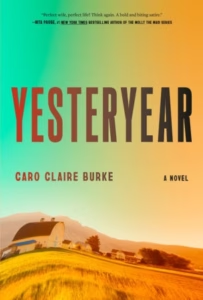
I was about halfway through Caro Claire Burke’s upcoming novel Yesteryear when a coworker asked me what my book was about, and I realized that I had no idea.
In Yesteryear, Natalie Heller Mills is a tradwife influencer who lives on a picturesque farm, with her husband and their six adorable children. There are a few cracks appearing in her perfect life, and sure, she’s got a busy off-camera staff to make it work, but mostly her days are about kneading sourdough in her gorgeous farmhouse kitchen, or posing with her beautiful children.
Then there are these there scenes where Natalie is somehow transported to living on the old-time frontier. She’s still Natalie, with her memories of her life, although her children are different people and her frontier husband is a weather-beaten, sullen version of her regular husband. Natalie’s still cooking all day, but her it’s not gorgeous homemade recipes for her Instagram audience, she’s trying to knead enough tasteless bread for the family or hand-wash the family’s clothes.
I wasn’t sure where this book and this time-jump were going. Was it magical realism? A cursed Insta post that threw Natalie back in tradwife time? I recently read Ann Liang’s I Am Not Jessica Chen, which uses a supernatural element to tell a story about identity and jealousy, so I thought maybe Yesteryear is including a supernatural element to talk about farm-wife aesthetic and actual women’s labor in the real past.
The story in Yesteryear starts out mildly confusing because there seem to be two timelines, and even in the present-day one, the narrative jumps around in time to reveal Natalie’s life. It was fine, though, because I was so invested. Something about the manufactured perfection of influencer life is so compelling in fiction. Her whole lifestyle invokes a past era of beautiful soft-life homemaking wives, even as she manipulates her husband and works incredibly hard for it.
Plus, that manufactured perfection and simplicity is funny, like when she’s spotted at Target, which would break the illusion of homemade jam and bread and pickles and everything simple, she posts a quick video about how it’s a rare treat day, to keep the story going. But is the joke about Natalie faking her life for clicks? Or is the joke on the viewers, who believe that Natalie looks after 6 children without ever running to the store, or believe that a couple runs a farm without help?
I found the book darkly funny, but with these confusing scenes of actual pioneer life that felt just plain dark.
The truth takes a while to unfold, and I loved that I didn’t see a lot of it coming. There are some obvious reveals in her tradwife influencer life. I mean, it doesn’t even count as a spoiler to tell you her finances are not as they seem, and her marriage has the problem you’ve probably already guessed. But these aren’t told as shocking revelations, just as another obstacle Natalie must pass to reach her goal. Yesteryear has a deeply unreliable narrator who’s telling one thing to her followers, another to her husband, another to her staff or her kids or the readers. She’s even lying to herself a lot of the time. It’s so fascinating, and I just couldn’t put it down.