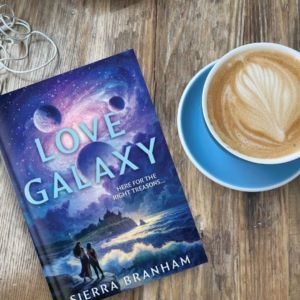
Love Galaxy, by Sierra Branham, offers a unique mashup of things I love in fiction: A reality-show backstab-fest crossed with layered galactic diplomacy.
Trash collector Artemis is working a double shift when she tells some spoiled rich kids to move away from the dumpster she’s trying to empty. Those rich kids, though, are the twin heirs to the galactic empire, sneaking out for a smoke on their boring publicity tour of the backwater outer belt planets before their season of Love Galaxy, the imperial-consort search/dating show, begins, and after a shouting match and a PR smoothover, Artemis — Temmi — suddenly finds herself one of the 24 contestants vying for the two imperial marriages.
This is very much The Hunger Games in space, and Temmi’s home of X72 is very much District 12 in space. It works because we all love The Hunger Games, and because in Love Galaxy, there’s an explanation for life in the poor backwater planets. The dangerous, backbreaking mines of X72 provide a substance needed for essential jumpgates throughout the empire. There are references to the shared galactic history that developed the other different cultures, as well. But, unlike The Hunger Games, the reality-show contestants aren’t supposed to be dying off.
The purpose of this season’s Love Galaxy dating show is to find consorts, but also to show viewers across the empire beautiful women from different subcultures, and show everyone getting along. This part of the world is so well-developed. Love Galaxy gives us ancient grudges and regional accents to hint at generations of imperial history. The contestants joined the shows for a wide variety of public and private reasons, which develops intriguing characters and drama. Mostly, I wanted to hang out in Petra and Rosina’s room.
Sections with weird pacing dragged this down. I mean, we get it, Spie is horny, Nix is secretive, and Temmi doesn’t want to be here, except if it goes well, she could bring home plenty of money for her family. There were endless chapters with dramatic events in the well-developed spaceworld with complex secondary characters, and in the aftermath of *latest plot event* Temmi dramatically realizes (again) that this show is her one chance to help her family. Spie is horny again, Nix still has a secret, probably a Dark Secret. We readers don’t need quite so many examples to develop characters, let’s get on with the murders and galactic secrets!
I found this same repetition of character development and slow advance of the overall conflict in another scifi romp, Kitty Cat Kill Sat. Later, I found out it was originally published as a serial, so maybe Love Galaxy was also episodic at one point and the repetition is part of that. Wildly different stories, but similar vibes for me.
The romance is perfectly fine, although it suffers from the same repetition. Yes, yes, we get it, you live for your secret moments of texting. I know I’m in the minority on this one, but I don’t much care about “banter” between love interests. It usually feels forced, and we readers lose character development for witty exchanges. Plus, I don’t think insult-banter is particularly compelling when there’s a real power differential between the two. So, the whole secret texting relationship was kind of an eyeroll for me, and unfortunately, that’s a big part of the sapphic love story.
I just can’t overstate how much is going on in this world, and how fun it is to explore it. It’s often hard to develop a full world in scifi without info-dumping, but it worked well here. As I read, I completely believed that some outposters are tough, hardy loners, while other distant worlds built strong community ties out of the hardship and isolation. I believed that there were Empire luxuries that Temmi and other outer belts contestants had never experienced, and that other contestants had trained in diplomacy for years for the spot on the show.
Since there’s so much going on in Love Galaxy, I started to wonder how so many plotlines could possibly get resolved, but the short answer is just that they don’t. The ending isn’t really a resolution, as much as a setup for a series. It’s fine because I’d read another book set in this world, but I felt a bit cheated when we never find out about some of the intriguing secondary characters and their goals. (Petra forever)
[…] Slice-of-life scifi can be so fun to read, especially with multiple civilizations and factions. (I loved this in Sierra Branham’s Love Galaxy, too.) Arcadia and Blaze have the perfect perspectives to share the world with readers, because for […]