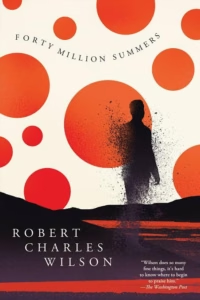
Forty Million Summers, by Robert Charles Wilson, introduces a truly alien lifeform and a fascinating deep-time premise, but as I read, I found the human characters a bit underwhelming.
With the world about to end, a few scientists at a midwestern research facility attempt to protect the humans they can by creating an experimental bubble over the research labs, saving about a thousand people by moving them 40,000,000 years into the future.
For me, the primary draw of this book was the wild creativity and possibility of its far-future timeline, and then when I read, I also discovered an alien life, with the same sense of creativity and possibility. I’m often drawn to science fiction to imagine something wildly new, and this book absolutely delivers that wild sense of possibility. The author introduces an alien life that really feels alien, and these lifeforms with non-human logic and unfamiliar experiences are fascinating.
The beginning of the novel is a bit rough, with a lot of that “as you already know, Jim,” style of exposition to introduce the world-ending phenomena, the experimental bubble, and the relationships between people in town, but I was intrigued enough by the promised deep-time adventure to roll with it. Besides, with an ambitious sci-fi world, you often need a bit more explanation to set things in motion than other genres require.
I was slightly underwhelmed by the deep-time premise promised by the title. The actual story’s fine, I just wanted to see more of the immediate aftermath of the bubble — for the characters inside, they’re just a few weeks out from Netflix and commuting, and they’re discovering everything they ever knew is gone. Friends and family who were out of town that day are long gone, any possessions left behind have been dust for millennia. But we don’t really see characters adjusting as much as we jump forward to years after, when there are relationships and factions already established in the fledgling community.
For the humans in Forty Million Summers, a lot of the book is a survival adventure, and with more ladies in it! Like, multiple female characters who aren’t just there to be sexy and get rescued! There are multiple women who are very good at what they do, and they’re good at different things! That was great. There’s also a faction who expressly want women to marry and have children, instead of foraging, teaching, exploring and leading, and this was particularly effective for me because the novel gave us such a solid counterpoint of post-apocalyptic women working in medicine, teaching, hunting, etc.
I loved the new and truly alien consciousness in this novel, too, with consistent and foreign thoughts, and goals and priorities that made sense over the eons of its lifespan. The first contact (or the two first contacts?) was fascinating and compelling. Loved it, but it’s hard to talk about without giving spoilers, and you really want to read it and discover this for yourself. I can’t sum this up and do it justice.
Forty Million Summers is the fourth Tachyon book I’ve read, and it’s the third time I’ve fallen into an amazing specfic world, unfolding with just so many intriguing ideas, and told with weird pacing. Not bad pacing, exactly, just not the expected pattern of rising action and developing plot. When I read Meg Elison’s Foundling Fathers, I thought I was getting into the setup for a novel, but it was actually more of a thought-experiment novella. In Love Galaxy, I wondered how everything could be resolved in time, before realizing this is the first in a series, and it’s not all going to be resolved by the end of the book. And here in Forty Million Summers, the story unfolded unevenly, with lots of description in some places and then a jump forward to years later. For example, the novel includes long descriptions of individual future flora and fauna, and I thought since so much time was spent on these, that I must be getting clues about evolution or about their culture, not just excessive setting detail. Also, part of the social conflict hinges on Jack and Shannon’s refusal to get married, which is never actually explained. Were they making a statement that I didn’t catch? Had Shannon had a husband 40,000,000 years ago? We don’t see any moments of them falling in love or being particularly affectionate or romantic, so I wasn’t entirely clear what brought them together either, but I accept two perfectly nice people deciding to be a couple.
I felt slightly cheated by the ending for the humans, because we’d been set up for a dramatic conflict with a faction wanting to leave and their plans to steal all the resources for themselves, but then the ending mostly defeated the villains through random accidents. This matches the overall theme about random elements of survival, a theme shown throughout the novel, but it still fell slightly flat for me.
Ultimately, Forty Million Summers works as an compelling imagining of alien life, an interesting encyclopedia of speculative far-future biology, and a post-apocalyptic adventure story, but some of the human storylines and personal relationships still left me feeling underwhelmed.