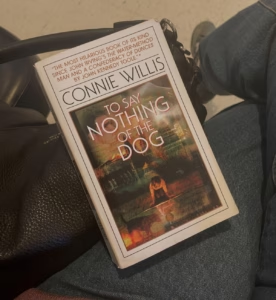
 I loved Connie Willis’ Doomsday Book, and To Say Nothing of the Dog, but somehow missed that there are two more novels in the Oxford Time Travel series, Blackout and All Clear, and I was delighted to find them and go back to this world.
Blackout and All Clear are more like two halves of the same book, really. Blackout ends on a cliffhanger and the story picks up immediately in All Clear. Thankfully, I’d already requested both of them and had the second one ready to go on my Kindle.
 In the beginning of Blackout, more Oxford historians are preparing to travel back in time to observe different aspects of WWII. I was hooked from the start, the descriptions of their prep to join the Singaporean expat community, to look after evacuees in the countryside, to work at Bletchley Park, and just observe all different aspects of WWII.
Merope’s cover story is a maid at a countryside estate, where she knows a group of London evacuees are about to arrive, and she will observe life for the evacuees. Polly is researching shopgirls in London, so she goes through to get a job and rent a room, armed with a list of shops and streets that weren’t bombed in the Blitz. Michael Davies is observing Dunkirk, specifically the fishing boats and recreational ships who aided in the rescue.
These are supposed to be controlled historical observations, well-organized trips with well-prepared historians, just the way Mr Dunworthy would like it, and by 2060, there have been loads of successful history trips to the past after Kivrin almost got stuck in the 1300s in Doomsday Book. But there are strange warnings about slippage and errors. Slippage, in this world, is the slight difference between the scheduled opening of the net and the actual opening of the net. Slippage can be caused by a contemp (regular non-timetraveling person going about their regular life) walking by or other unforeseen circumstances that prevent the net from working. I like that the Oxford Time Travel world explains that the net won’t open if it will affect history, because it skips so many pedantic questions about time travel and gets right to the story.
We readers are set up from the start with Mike’s assignment, which will be researching how ordinary people react to danger with heroism. He thinks he’s talking about fishing boat captains making a dangerous trip but readers discover pretty quickly he’s really talking about the historians themselves. We’re also set up from the beginning with Colin telling Polly he loves her and will do anything for her and yes, seventeen is very young but if he uses time travel, he can catch up to Polly in her early 20s.
Yes, Mary’s great-nephew Colin from Doomsday is a teenager now, and he’s aged up realistically. As the story unfolds, this is absolutely the kid who’d sneak through the time-travel net to the dark ages, with his flashlight and a packet of aspirin. We also get to see Dunworthy and Badri again in Blackout/ All Clear. Badri remains the skillful and efficient tech, give that guy a raise. And poor Dunworthy is still stressed about the safety of sending his students on historical drops.
Blackout quickly becomes a WWII historical novel, with no scenes set in 2060 Oxford after Merope (as Eileen), Polly, and Mike have all arrived on their separate assignments. Polly’s story was the most interesting to me. Working in a wartime shop combined normal retail days, dealing with customers, with wartime upheaval. The shop girls are expected to be on time and in uniform, even if trains aren’t running to get home or back. There are endless romantic possibilities, and everything is a bit heightened, but these are encounters with soldiers passing through, who might be married back home, or engaged, or sent to to the front and never heard from again. This part felt like a historical novel, except that Polly was also trying to find her drop or meet up with other time-travelers to use their drops.
The historians each find trouble with their drops, and since they aren’t aware of what’s happening back home in Oxford, the reader doesn’t get a hint either. Well, everyone — characters and readers — knows Dunworthy, Badri, the rest of Oxford team, and especially Colin must be doing their best to get everyone back home, but with no idea why the drops aren’t working or when they might see a rescue team.
I wasn’t sold on the beginning of All Clear. Some of this is my personal taste: I just hate when Character A decides not to worry Character B by telling B all the necessary information about their mutual situation. I especially hate it when it’s clear that then character B, without knowing there’s a problem, has no reason to think they’re carrying the Macguffin or they know the secret password or whatever, so they don’t mention that either. Ugh.
A lot of All Clear, especially the beginning, is just characters scurrying around, looking for each other in the Blitz, having their trains cancelled or delayed, and I understand the historical impact and the time-travel significance of being a split-second late, but other people’s commutes do not make for riveting reading. (There’s a bit of this feeling in Doomsday Book, with poor Mr. Dunworthy trying to get in touch with other people. I know the meaning for the narrative is about the billions of tiny choices and actions that ripple out and affect our lives, but a character checking for messages is not a riveting scene, either.) It works for the overall theme, though, as the novel asks if the time-travelers might be changing history and upsetting the time line by being there. Does a tiny choice make any difference? Could a change remark change a person’s life or the course of history?
I don’t really want to talk about the conclusion, because it’s so well done that it almost cheapens the careful setup to attempt to summarize it. It’s such a solid, fulfilling ending. Parts of the conclusion have been set up from the very first pages of the first novel, and then more has been revealed and suggested throughout both books, and yet there are still surprises at the end.